Sunday, 14 November 2010

Winter warmers

This week I have been sorting out my belongings that got packed away before my new floor was put down. I have then got my fab new curtains up and new bits and pieces in, and I'm really quite liking my living space. I also put up the 3 pictures I bought about 2 years ago, that have been stored still wrapped up in my downstairs toilet since I got home. They are by Eric Kean, a contemporary artist who died in May 2008 (only 6 months before I bought the paintings) whilst queuing to go through to departures at Liverpool John Lennon Airport. I bought Land, Sunset and Horizon, and they are looking really smart.


H pricking the sloes

Also this week I collected sloes to make a batch of sloe gin with. The best time to pick the sloes is after the first frost. It is tempting to collect them earlier, so the gin is ready for Christmas, but if you can hold out until the frost apparently it is a good thing. We have some brilliant sloe trees just at the back of our house, and right in the middle of them, quite high up, were masses of big plump sloes. On Monday lunchtime I had a walk out and was looking fetching, in hiking boots, a parka, and a woolly hat. I eased my way into the tree and managed to pick loads of sloes before extracting myself, with bits of bush sticking out of my hair and mud all over my jeans and boots. I had a quick walk to feed the ducks when disaster struck. In my dishevelled state I walked straight into the young man I carry a bit (OK a lot) of a torch for. I'm hoping he will come to taste some of the finished product. Paul just thinks I'm really sad getting in a state over a young man at my (tender) age.
Day 3 of sloe gin
We had a family bonding session preparing the sloes. We even had H pricking their skins. Then we had to poke them through the necks of the bottles I had, shove the sugar in, pour in the gin and shake. The bottles are now safely in the cupboard under my stairs where I give them a shake twice a day. I think it will be spring before the gin tastes great, but it is already looking a gorgeous colour.

Saturday was Twiglets (Tottington Wildlife Group) day. 7 or 8 children turned up with about the same number of adults, and we went to our field to make mud masks and twig sculptures. We had to pick up mud and mould it to tree trunks so we ended up caked in the stuff. Everything ended up in the washing machine when we got home. The kids love it - they get to spend an hour and a half outside getting mucky, and learn things as they go. Next month we are having a camp fire which should be great.

Today I went to my first Remembrance Day parade in Bury. I normally go to Ramsbottom in the morning then Tottington in the afternoon, but as H is in the cubs now he was taking part in the big parade. I only have to walk past a brass band and I start crying (I have no idea why, I just get such a lump in my throat) so by the time we got to the memorial at Bury Parish Church I was in a state. There were so many young people involved and they were brilliant. They have a parade, a service outside, a church service, the another parade back to the town hall so they were out for 2 1/2 hours, with them all behaving impeccably all the time.

The most moving Last Post I have ever heard was at the Menin Gate in Ypres in 1999. FB and I had found ourselves in Belgium almost by accident. We'd been camping in France, gone out for a drive, and, oops, we were in another country. We stayed a while as I found the roads easy to drive on. We went to the In Flanders Fields exhibition, but didn't go into the reconstructed trenches as FB was afraid. We also didn't visit the cemetries nearby as the weather had changed to rain (it did a lot of that during the holiday) and I'd put FB in a summer dress with little sandals, as we weren't intending going far. The Menin Gate is the war memorial dedicated to the British and Commonwealth soldiers killed in the Ypres Salient in World War 1 whose graves are unknown. The huge arched structure was unveiled in 1927 by Lord Pulmer, who said "He is not missing. He is here." The names of 54,896 Commonwealth soldiers who died without graves are etched on the structure but although vast, the memorial couldn't fit all the names on it as planned. A cut off point of 15.8.17 was chosen, and the remaining 34,984 names were instead included on the Tyne Cot Memorial to the Missing. On every night since 2.7.28 (apart from during the occupation of Germans in WWII, when the Last Post was heard each night in Surrey instead) at 8pm buglers have sounded the Last Post. In WWII it was resumed at Menin on the night Polish troops liberated Ypres, despite heavy fighting still happening very near by. Seeing the names inscribed on the memorial really makes you think about how lucky you are. Today, when H complained that he had to endure a '20 minute silence' and lots of standing up, we reminded him how preferable that was to a day in the trenches, cold wet and hungry, feeling lucky to be in the trench and not having to go over the top.

Next week I'm having a social life, so I may give you something less boring. I'm also spending quite a lot of my spare time on a project that I can't reveal just yet, but it's coming together really well......

Sunday, 7 November 2010

Frightening Feeding Time for Fish

I was going to have 'Anyone for monkfish?' as this blog title, but although I intended to go to Gorton Monastery and take in the Universal Worship Service (for people from all faiths or none), I ended up at Ikea. It perhaps wasn't a bad thing. Too many new experiences in a day can't be that good for you.

Where to start.....I've had the strangest Sunday morning experience I've had for a long long time. It wasn't altogether awful but it did freak me out somewhat. I have to say I didn't want the experience, but was talked into it by Ms. A, who for the past few days has been telling me she needs to discuss fish with me.


We finally got around to the fishy conversation yesterday, and weirdly enough, as soon as it started it dawned on me where it would end. About 3 weeks ago I walked through Bolton town centre and saw people stood in a fish tank (with fish in). At the time it didn't occur to me that it was anything other than a prank - maybe a charity stunt. This week while stopped at traffic lights I noticed a beauty salon advertising fish therapy. That sounds awful, and the thought of having the likes of a fish facial didn't tempt me in. Yesterday though I walked through Bury and overheard an older couple stood in front of another salon. The wife was telling the husband that fish in tanks eat dead skin off your body, and it is a new 'thing'. As soon as Ms. A phoned me later on, it all slotted into place! She was telling me about Appy Feet that has opened up in the Trafford Centre, where you go for a pedicure with a difference. My feet are fine, but she managed to talk me into not only accompanying her, but participating in the experience. We decided to go to the Bolton salon (Yoko in the Market Place, Bolton) as it was more convenient. I was collected and driven to Bolton to find out what it was all about.

The fish tank


A Garra Rufu Fish Therapy Experience is supposed to leave your feet very smooth, give you a feeling of well being, stimulate the growth of new skin cells, and provide relief for skin disorders such as eczema and psoriasis. Basically, the fish eat the dead skin off your feet. We missed a trick really. With the amount of dry skin on Ms. A's feet we could have charged the salon as the fish wouldn't have needed feeding for weeks afterwards.

Having my feet checked out
A good wash of the feet first
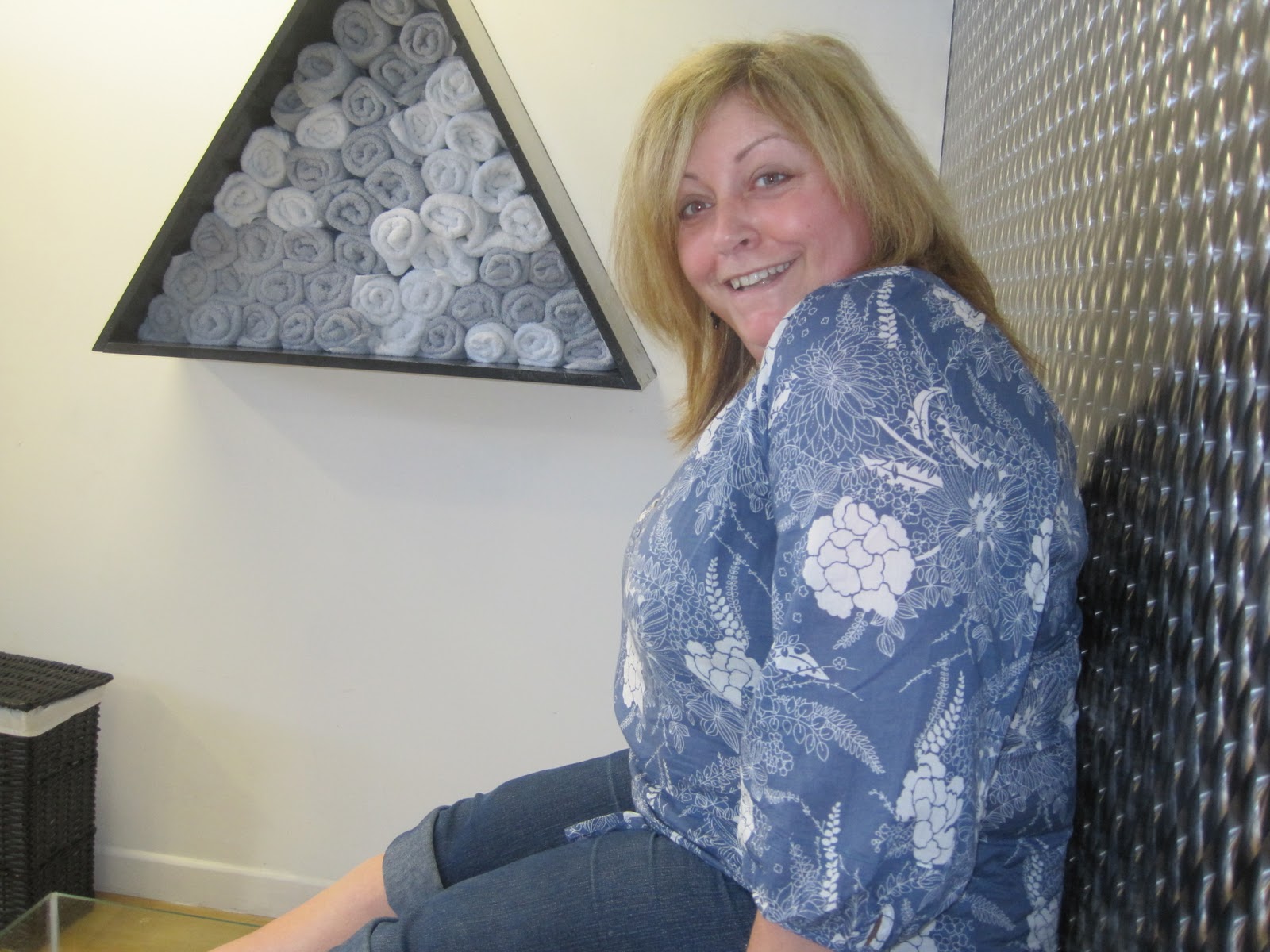
There are 2 sections in Yoko, and one of them is screened off so people can be private. It was explained to us that some people may have psoriasis that they don't want others to see, and they are more comfortable (or not as self conscious, as 'comfortable' may not be a good way to describe it) away from curious eyes. We don't mind an audience and so were fine with the idea of rolling up our jeans and sitting with our feet in a fish tank in an open shop front with half the population of Bolton coming for a look. Before the treatment started we had to have our feet inspected. We were asked if we had had any verrucas recently, any athletes foot, or any deep cuts that wouldn't heal. When they were satisfied that we wouldn't poison the fish we could sit next to the fish tanks with our feet in a foot spa. This is just so they know we have had a wash in our own personal water before having a dip in the communal bits. Before long, it was time for the experience to begin.


The hungry fish
The feet have gone into the tank
Work in progress
The bottom of Ms. A's feet
We were advised to slowly put our feet into the tanks, but not look as we did it. The look on Ms. A's face made me want to escape, and the fish started their meal straight away. They were like a school of pirhanas attacking. It took me ages to put my feet in my tank, and then it was so awful I pulled them straight out again. It made me jump because I thought some of the fish might have ended up on the salon floor, and I had visions of me being charged for the fish I'd killed off. They stayed in the water though, but I did get told not to scream again as it frightened the fish (never mind potential customers). I slowly put my feet in again and this time kept them there. It is a really strange feeling, that is very similar to having your feet in a jacuzzi. If you don't think or look, it isn't unpleasant. The fish don't half get stuck in as soon as they see the flesh though, and to me the weirdest bit was when they went in between my toes. They don't just do your feet - some of mine were experimenting further up my legs. We were advised that if we wanted them to concentrate on the bottom of our feet we should just put our soles in. That tickled far too much for me.

A relaxing spa treatment?
As it is a bit of a spectator experience we did drum up some more custom while we were there. The other people having a go all said that it was enjoyable. One man put his hand in his girlfriends fish tank and he wasn't too keen though. We were assured that the fish don't have teeth. It is something to do with enzymes on their saliva breaking down the skin so they can lick it off, but I haven't looked into the biological details yet. Only one person has licked in between my toes before, but he didn't chew any dead skin off while he was at it. When our time was up we could dry off, smother our feet in moisturiser, and go on our way. My feet are really smooth, and Ms. A's are in a much better state than they were. She was very impressed with the outcome. I'm not sure I'd do it again, as I'm really soft  (i.e. a coward) and don't particularly need it, but I would recommend it for anyone with a lot of dry skin or a skin condition.

One thing to note though. Although the fish do seem to smooth your feet, just like a pedicure does, they don't paint your nails at the same time. However, 8 hours later my feet are exceptionally soft. If you are brave enough, go for it!


Sunday, 31 October 2010

An Englishwoman Abroad

I have just returned from my first trip abroad taking just H. Paul had wanted us out of the way as he had jobs to do at home, and it would have been daft not to oblige. I gathered up my air miles and booked our flights to Basel. We are very lucky to have friends there who we could stay with, and even luckier that they happen to have a chalet in the Alps too, to give us even more variety.

We had to fly BA via Heathrow in order to use my air miles (I'd left it too late to get Swiss flights direct from Manchester), and we were treated to a low flight over central London before landing. It was a clear morning and it was brilliant to see all the landmarks from above. We got fantastic views of Big Ben and the Houses of Parliament, Buckingham Palace, the London Eye, the Albert Hall, Wembley etc, and H loved it. We got the same views on the way home, although it wasn't as sunny a day, and that more than made up for the inconvenience of having an extra flight.

Dreilandereck, Basel

We arrived in Basel** without too many traumas. We had run for our flight at Heathrow as H had been in the loo when the final call was made, and when we got to Basel, H got stuck on the wrong side of a security door. We were the last passengers going through and I went first. The doors wouldn't open again for H,and there was no-one around to tell. I had to speak calmly to him though the glass for around 5 minutes before they decided he could enter Switzerland after all. I say "enter Switzerland" - you have to be careful at Basel airport as it serves 3 countries. The airport is actually in France, and you have to choose which exit to use, to take you to roads into either France, Germany or Switzerland. I am always fascinated (it doesn't take much) by Dreilandereck, the point where the 3 countries meet.
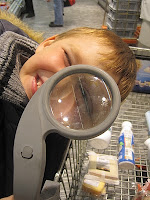
H with the thoughtful trolley!
We were met at the airport by A and JC, and the first job was to go to the Coop to get a few essential provisions - wine, and bread and cheese for fondue! Even the trip to the supermarket was enjoyable. The trolleys are fitted with magnifying glasses so shoppers who can't see too well can look at the labels in detail! Apparently during a hot day at another store a baby's seat started to melt when the sun had been shining through the glass for a while outside. These trolleys can now only be used when they are kept inside!
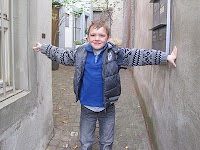
H at Pfeffergasslein, the narrowest street in Basel.
A and JC live in amazing duplex in the city centre, on the narrowest street in the city (1.11 metres at its narrowest). The street can only be reached by walking either up or down many steps (from where they park it is down to get there). The building is very old, and they have the fourth and fifth floors. There is no lift, and the upper floors are reached by climbing a narrow spiral staircase. You do get used to it after a few days, and if I spent a month there I would come home with an amazing bottom, but getting your case up on Day 1 is a killer! I always need a little lie down when I reach the summit.

After a fondue, a couple of bottles of wine and an early night, JC went to work, and A, H and myself got ready for our Alps expedition. We were going to Inden, in the canton of Valais. Although this isn't that high up, the views of the really high mountains as you travel are awesome. The journey is made easier by the train that takes you through the Alps from Kandersteg to Goppenstein. This is more of an engine pulled trolley that you drive on and then wait in complete darkness for the 20 minute ride to be over. Before we got on the train there was snow on the ground all around, and the atmosphere was quite damp. When we came out at the other side it was like when you get off the plane in another country. There was sun, blue sky, and to H's disappointment, no snow! As we got into Inden we could see snow not much further up though.
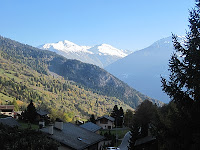
View from the chalet in Inden
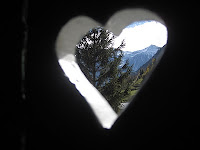
We arrived at the chalet and when the water had been turned on, we had to get the fire going. It didn't take long at all for us to be so snug we didn't go out for the rest of the day! We had dinner and settled down to watch a DVD. H was having a marvelous time, partly due to being able to play on A's iPad,which is now on his list of things 'I' need to save up for. The chalet is completely pine clad inside, and this soaks up the heat. Before we went to bed we left the bedroom door open for a while to warm that up, and we slept with the bedroom door open to keep warm throughout the night. Inden is a tiny village, very dark, and our chalet was not overlooked so there was no need to close the bedroom shutters at night. Waking up and immediately seeing mountains was great!
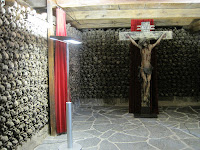

Das Beinhaus

We had a leisurely breakfast and then set off for a day out. First stop was Leuk Stadt, just further down the hill. There are great views from the small town, but we were there to go to St Stephen's church, built in a late Gothic design and completed around 1500. The church is only small, and it houses Das Beinhaus - a bone chamber which is a Black Death memorial.* This is a really weird place. There are walls, each a few metres thick, made completely from skulls and bones retrieved from black death burial grounds. These are full walls, built around a church that is in use. H wasn't keen on them but was fine. I had decided that as we were going he should see it as it was historical and educational, although I'm sure many would disagree. We weren't there long before we continued our journey, the next stop being Sion. Sion is in the French speaking part of Switzerland*** so I was slightly better at the language. We had gone to Sion to have a look at the shops and have lunch in the Manor (a shop I like) restaurant. After a quick look around we nipped back to the chalet to collect our swimming things, then went off to Leukerbad, about a 10 minute drive up the hill.
View from Leukerbad in the evening
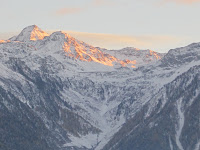
Although Leukerbad is so close to Inden, it took us to the land of snow! There wasn't much, but at least H could mess about and put it down our backs etc. In Leukerbad we went to Burgerbad, the largest alpine thermal spa in Europe. There are 10 thermal pools in the complex, between 28 and 43 degrees C. The complex is 1400 metres above sea level, and most pools are outside. It is amazing to swim outside in water as warm as bath water, but with freezing air on your face, with mountains on all sides to look out on. There are waterfall showers and massage jets, and lots of different places you can sit or lie down while the Jacuzzis relax you. There are the freezing cold then hot plunge pools to increase circulation (I didn't bother with these!), and there is a natural rock grotto (I've been in this once and never again - it is a bit creepy and smells of wee). You have to brace yourself for the cold air as you move from pool to pool. We were in the water for over 2 hours and so were very wrinkly (yes more than normal), but you can go for the day and have a lounger (indoors) to have a break from the pools. After our swim we ventured higher up, and had a walk to a waterfall and the source of the spas. Although we hadn't had a particularly active day we were all completely tired out and another early night was needed.
Through the window shutters, Inden
We had a massive lie in the next day, before we got our things ready and closed up the chalet. It wasn't a nice journey back as we hit the commuter traffic and there were a few accidents. When we got back to Basel we didn't stay in long before we went to see Herbstmesse, the autumn fair which people come from all over to see. Fairgrounds are set up all over the city (nice ones, not like we see at home!), and one green area has lots of individual stalls and places to eat. We went on the ferris wheel, which takes you as high as the Manchester Wheel, but you aren't completely closed in. We didn't get there until dark but the views were still great. H got his go on the dodgems so he was happy.

We had to leave the next day, and H would have given anything to stay. He loved spending time with A and JC (who are always a hit with the children), and can't wait to go again. We had to carry the case down all the stairs again, then along the street and up steps back to where the car was, then are 2 flights before getting home. I love going to Basel and have been at least once a year for quite a few years now. I think I'll have trouble sneaking off for a few days by myself now though. I won't get through the door without H!

* The Black Death is Europe's greatest disaster - a third of the population died. It hit Europe in 1348. In spring 1348 it was rumoured that it was caused by water pollution, and it was then said that the wells had been deliberately poisoned by Jews. In the summer of 1348 a doctor, while being tortured on a rack in Chillon in Switzerland, admitted to poisoning the wells with a powder sent to him by a Rabbi in Spain. In October it was decided that this confession was proof enough that Jews were responsible for the Black Death. Basel burnt all its Jews, and in the next 9 months through Germany and up to Flanders Jews were burnt in their tens of thousands (in addition to those dying of the plague). Fleeing Jews went to Poland where they were protected by the king, who is said to have had a Jewish mistress. This migration therefore brings into Poland, and subsequently Russia, large communities of Jews speaking Yiddish - their own version of German developed in the medieval centuries.

** Basel is divided into Gross Basel and Klein Basel by the River Rhine. Outside a restaurant on the Rhine at Great Basel is the Lallekonig (tongue king) who sticks his tongue out at Little Basel. The city is on the borders of France and Germany, and a railway station is at each end of the city to take people to the respective countries. 6 bridges link the 2 sides of the city, the first one, at the site of the current Mittlere Brucke in 1225. There are also 3 small passenger ferries going between the sides that are driven by the tide. People swim in the Rhine, and there are signs at the side telling people how to do this safely, as many large and fast boats are on the river. Special bags can be bought so you can undress on the banks of the Rhine and put your outer clothes on this bag, put it across your body, swim down the river (mainly being carried by the sometimes very fast tide), and have dry clothes when you come out! There are several festivals throughout the year in Basel, the most famous being Fasnacht that it on different dates each year depending on when Easter is. This festival starts at 4am on a Monday morning, when more people are in the city centre than live there. All the lights go out and from every little street come groups carrying lanterns and playing piccolos. The festivities continue until Wednesday night, and they follow the same format each year, with times for parades, lantern displays and concerts. It is an experience I can't adequately describe, and after 3 days you need to sleep for a week!

*** There are 4 official languages spoken in Switzerland - German, French, Italian and Rumantsch.

Sunday, 24 October 2010

Save Our Police Community Support Officers

FB moved house this week and is now resident in what she says is a huge attic room in a shared house out of the town centre. She now has to buy her own food, so has paid me a visit several times. She also needed towels, so I came in handy for supplying those too. I hated taking her back at night, not because I didn't want her to go, but because I don't like going out at night, and for the first time this year I had to de-ice the car before I set off. It's only October for goodness sake. I then found out that she gets a free bus pass, not just for college but for any day, any time, throughout Greater Manchester. She turned up last night and was horrified when I said she had to catch a bus to go home - she had had a long day!

People's History Museum, with Justice buildings!
Yesterday I went to the People's History Museum in Manchester for the first time. I blogged about the Death and the Working Class exhibition yesterday, as I wanted it to be down as my story before I sent it anywhere else. The rest of the museum was excellent too though. It really is all about the working people of Manchester in particular. As you enter the exhibition space you see Anthony Bennett's clock sculpture from 1994, that depicts the changing relationship workers had with time during the industrial revolution. Into the exhibition you hear about John Wilkes (the ugliest man in Britian or so they say), an MP who demanded an end to corruption in the government and was sent to prison for his outrageous demands! We hear about the Tolpuddle Martyrs, the Peterloo Massacre, and about how music has always been associated with working class politics, with the Stalybridge Brass Band marching the the Peterloo Massacre in 1819.

Anthony Bennett's clock sculpture


The political parties (mainly Labour) and various campaigns are covered and you hear about the 1st group of 29 Labour MPs in 1906 wanting pensions, womens suffrage and school meals - very new ideas for the times. After the huge Labour victory in the 1945 general election the Welfare State was implemented, and the next year saw the start of Family Allowance. Oh, how times have changed....

After Manchester we had to go to our favourite Italian restaurant, Bella Italia, as it had been refurbished. The food is just as good, and at £25 for the 3 of us it is great value. It is lovely inside, all coplour coordinated with the waiters even having the same coloured ties as the napkins. However, it has lost something, and not just all the bottles that used to hang from every bit of ceiling space. There are still some bottles hanging from the beams, but they are all arranged, with all the chiantis together etc, instead of a mass of everything. I'm sure it will be a big hit though, and as it has been there years (I first went 25 years ago and it was far from new then), with the same owners, I think it will continue.

I went on the right day for the Bury Homewatch Conference this week, and it was a much bigger event than I imagined. We all sat with other Homewatch coordinators in our area. I felt like a bit of a fraud as I'm not our coordinator, but as there was no sign of anyone else I knew I sat down and took notes to pass on. I also picked up 3 big metal Homewatch Area signs that will hopefully please the neighbours, although rumour has it the council has to put them up so we don't damage the lamp posts.

The conference started with Chief Superintendant for Bury, Jon Rush, acknowledging the achievements of our very strong neighbourhood teams and the brilliant interaction between the police and the public in these teams Peter Fahy, Chief Constable for Greater Manchester Police was next on. He reminded us that Robert Peel's idea of policing was that it should be localy based, and the test off effectiveness is the lack of crime and disorder, not the evidence and statistics of police action. This week Lancashire Constabulary stated they may have to cut all their PCSOs. Fahy didn't give the impression that he was considering this for GMP. On the contrary, he mentioned cutting back office functions, but he did acknowledge that times would be difficult, and if he involved local people he would be more likely to get a solution. At the first whispering of our PCSOs facing the ace I think my next campaign, to save them, will start. If only I didn't have to work, there are so many other worthwhile things I could be doing.

Nick Foulkes, the emergency planning officer for Bury Council gave a presentation on 'Adapting to Climate Change - An Emergency Planning Perspective' that despite its title was really interesting. There are various plans in place to deal with flooding and heatwaves, and we had to adapt our infrastructure to deal with the wetter but warmer winters, with hotter summers.

The highlight (apart from being able to sit next to our PCSO, and no Ms A I won't be expanding on that!) was the presentation by Inspector Dave McElroy on domestic cannabis farms. Outdoor cannabis plants only harvest once a year, but indoor plants can harvest 3-4 times a year. He showed photographs of a cannabis farm found in a terraced house. 3 rooms each contained about 200 plants each, and the annual income from these would be in the region of £360,000. A £50K electric bill has also been by-passed by messing about with the electricals. This needs to be done as the national grid would immediately notice the surges.

Organised crime is often behind the cannabis factories, with these criminal identifying experts who can in turn identify and rent suitable properties, prepare the farm, and manage, harvest and distribute the cannabis. Empty commercial properties are increasingly being used, and there have been cases of underground farms being found in cellars. These have the advantage that they are harder to detect by helicopter. Apart from the obvious smell, things to be aware of are blacked out windows in properties, deliveries of fertiliser and ventilation tubes, and unusual comings and goings from houses. We then got a chance to sample (well, see and smell) the end product, including the full plants, cuttings, and the ground stuff. The whole of the Elizabethan Suite at the town hall smelt like a student party, with lots of elderly smiling faces around. I should point out that Harrison came with me and stayed until Paul collected him on his way home from work. He was the youngest person there, but (apart from the PCSOs, phew, just the thought cheers me up) when he left I was then the youngest!

I also found out about local PACT (Police and Communities Together) meetings. These were something else that hadn't been disseminated to our Homewatch members, so I'll be going to the next one on 1st November.

Tomorrow Harrison and I are off to my second home, Basel. We have to fly via Heathrow (to get my airmiles flights!) so we can take in terminal 5 and dream of what we could buy if we had the money! The autumn fairs are in Basel, so we are staying there on Monday night, then heading to the mountains on Tuesday for a couple of days. The idea is that Paul will fit a new floor while we are away. He has said it will definitely get done, but I will be amazed if I come back to it being completed! Hopefully I'll eat my words. I will be out of the world of wifi for over 2 days! I will have fabulous photos for next week though.

Saturday, 23 October 2010

Death and the Working Class

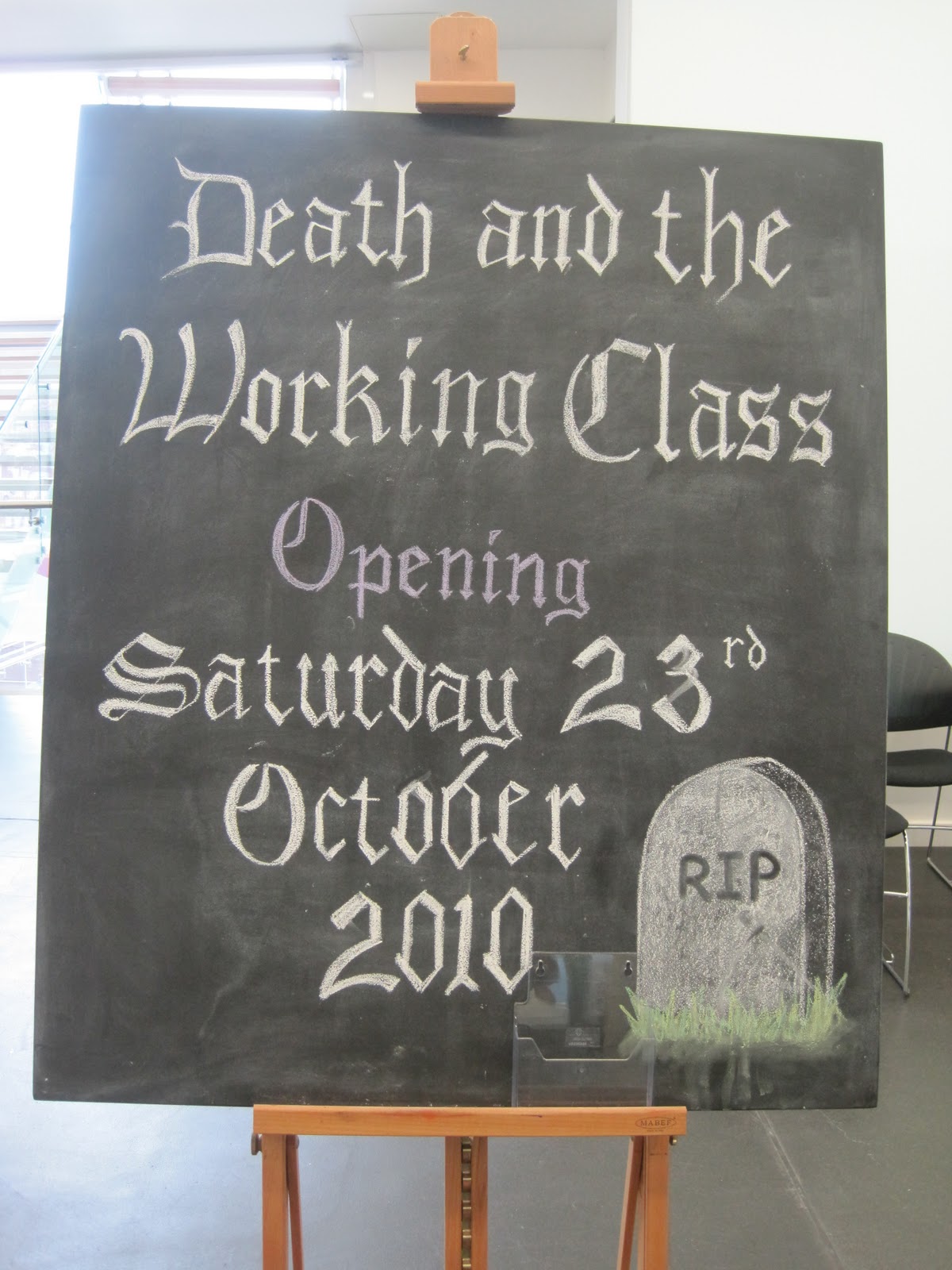
The People’s History Museum in Manchester has just opened its latest exhibition, Death and the Working Classes. It runs from 23.10.10 until 2.5.11 so there is plenty of time to pay it a visit. I went to the opening day so I could see the special events.

The exhibition looks at how the working classes prepare for death, and it shows the rituals and traditions around it. During the 19th and early 20th century dealing with death was a common experience for normal people. It was not uncommon for children, especially babies, to die, and if a child survived infancy life expectancy was low for the working classes due to poverty and disease. In some communities half of all children were expected to die before their 5th birthday.

Coffin handles and shrouds
The cost of dying was a great worry for the working classes in Victorian and Edwardian times, and people were encouraged to save for the event via clubs that would help out when the time came. The fear of dying without the necessary finances being in place was made worse after the 1832 Anatomy Act came into being. From this date any unclaimed pauper bodies were given to anatomy schools to be dissected. Prior to this, only the very worst criminals were given to the schools. Now, being poor meant there could be a total lack of respect for your body after death.

Most people died at home and would be laid out there until the burial took place. This had the benefit of guarding the body from body snatchers. As a mark of respect curtains were drawn and clocks stopped, and friends, relatives and neighbours would pay their respects. It could be considered disrespectful if a neighbour didn’t ask to view a recently deceased person. In the exhibition there are recordings of people’s experiences, and an elderly lady recounts being taken to see a deceased child who was to be buried in a bridesmaid dress that she should have worn for a forthcoming wedding. This lady has never forgotten being taken to a neighbour’s house by her grandmother to see a woman and her newborn baby together in a coffin. She even remembers that they didn’t have wallpaper in the bedroom or carpets on the stairs.

The exhibition gives the details of several pit disasters, including the Pretoria Pit explosion in Atherton in 1910, which is the worst pit disaster in Lancashire where approximately 343 men and boys died, and the Cadeby Pit explosion in Yorkshire in 1912 which killed 74 men, half of them being members of the rescue team killed by a second explosion.

Unions played a part in ensuring its members received a respectable and respectful funeral. They would loan out drapes for the coffin and would also loan ‘widow’s weeds’ – the traditional mourning dress for widows. Chairs and crockery would be routinely borrowed from neighbours and companies would hire ‘funeral urns’, tea urns to be used at the wake. You can even try on different types of mourning attire.

Funeral tea urn, that would be hored out for a wake.
Throughout the exhibition you can see burial savings cards, bills, room layouts, and a focus on particular deaths, including that of Ernest Jones, an important Chartist who had been imprisoned for 2 years in horrendous conditions for making a ‘seditious speech’. While in prison he wrote a diary using his own blood for ink. He died in Manchester in 1869, aged 50, after a brief illness, and an estimated 100,000 people lined the streets during the funeral procession from Wellington Street in Higher Broughton to Ardwick Cemetery. A Bakelite coffin from 1938 is on display. This was invented by James Doleman and at the time it was the largest plastic moulding in the world. There were restrictions on the manufacturing industry during the war and several undertakers have said they were offered plastic coffins as ‘removal shells’ after the war, as they could be cleaned out and reused.

During the opening day a 1933 Austin hearse and a horse drawn hearse were on display. The Co-operative Brass Band from Crewe plated (the exhibition is sponsored by The Cooperative Funeralcare), and the highlight was the coffin making demonstration, given by the Co-operative Funeralcare Coffin Factory in Glasgow.

Coffin making demonstration

The company make 400 coffins a day (100,000 a year, weekdays only), all made to order, and are the largest manufacturer in the UK. To start off, the head end is attached to the sides with glue and a staple gun. The ‘bottom’ is then stuck/stapled onto the top (so they work on it upside down) and the sides attached. I had never thought about it before, but coffin sides curve, as the shoulders are the widest part and it tapers down to the feet. ‘Curves’ are put at shoulder level. These are slits that go almost all the way through the wood to weaken it, so that it can be bent around. The coffins then go to the assembly shop, where the holes from the staples are filled, imperfections sorted out and it is hand-sanded. It then goes to another part of the factory where the lids, manufactured elsewhere, are married up. From here, the coffin goes to the polishing shop, and then handles are put on. There are 5 standard sizes of coffin, up to 6’5’’, and they always go by person size, not coffin size, as the thickness of wood would give a false measurement of the inside. The factory has made a 3’ wide coffin in the last week, for a 50 stone man, and they get special requests daily as people often want to personalise their coffin. They use a company that ‘wrap’ the coffin in whatever colours the buyer wants, or a design can be put on. You can even have a photograph adapted to go around the coffin.

Undertaking was often a sideline to joinery
This was my first visit to the museum, and the rest of it is at least as interesting as the new exhibition. I would thoroughly recommend it, and as it is free and suitable for children, it can be part of a great, cheap, day out.

Sunday, 17 October 2010

I love weekends

On Friday I had a meeting on Back Bark Street in Bolton. I recalled that my grandfather, John Edmondson, had his office on Bark Steet. I found out more, and the house was actually his family home, and he was born there. When he became ill he sold it, and it was turned into very expensive offices. I went to find it after my meeting, and it is now empty. It was good to get some photos though.
12 Bark Street, Bolton. Oct 2010.

12 Bark Street, Bolton. Early 1920s.


Dead pigeons in the craft centre.


We had a great day yesterday. H was at cub camp from yesterday morning until this afternoon, so we went into our wonderful city, Manchester, for the day. It always amazes me how much there is to do and see, and it needn't cost much at all. We got an all day bus and tram ticket and off we set. We had a walk around the Northern Quarter, and then went to the Manchester Craft and Design Centre on Oak Street. Most of the units are let now so there was loads to see. We also met Ms. A for lunch in the cafe. The centre is tucked away, and you wouldn't stumble across it if you didn't know it was there, but it well worth a look. We liked the clay dead pigeons in the stairway!


Mirrored building on Booth Street


From the Northern Quarter we walked towards Deansgate, going the quiet way to avoid all the crowds and see the new buildings inbetween all the old ones. We went to the John Rylands Library - a fabulous architectural delight that I can't believe I've never been in before. We went specifically to see the Elizabeth Gaskell exhibition, which didn't disappoint. I couldn't get over the gothic building. It was founded by Enriqueta Rylands in memory of her husband John Rylands who died in 1888. The Reading Room is amazing, and we ended up staying there for ages.


John Rylands Library

Flower display outside the library


Main staircase leading to the historic reading room at John Rylands.

We came out of the library around 4pm and I had a brainwave. Cloud 23 opens at 4.30pm, and we were so close.... To kill time we had a wander around Spinningfields, and came across a building site full of interesting silhouette statues. I'm looking forward to seeing the finished result. Paul had never been to The Hilton before, and although he likes real ale, as cheap as possible, he loved the cocktails and I had trouble getting him to leave! We had Thundercloud (vodka), Bloody Mary, Bramble (gin), Singapore Sling and Long Island Tea. We got a seat, and it was clear so we could see for miles. Cloud 23 is always enjoyed!

Statues opposite the crown court in Manchester, Byrom Street.

Manchester and the wheel, from Cloud 23

Coronation Street (see the Rovers Return) from Cloud 23.

Sunset from Cloud 23

Singapore Sling and Bramble

After all this we caught a tram to Victoria as we didn't think our legs could carry us. From there we walked to The Marble Arch on Rochdale Road. I love this pub, with its micro brewery and great food. We stuck to chocolate beer and ginger beer and got food. I had scallops and black pudding, and it was delightful! I also saw a sign for a limited edition beer called Vuur and Vlam (fire and flame) made for the Amsterdam Beer Festival. Only 518 bottles were made. Paul went to get that and a pint, and my bottle was £9.50, oops. We kept the bottle and will save it! Paul, who doesn't like to pay much, was fine, saying it was only like a cocktail. He must have had too much to drink. We stayed there far longer than we expected, caught the tram to Bury, and even managed to get the last bus to Tottington. We tried the local, which was still serving, so a quick half was had in The Robin Hood, then we found our way home.

Today, Paul looked dreadful, but coped. We went to clean out the cub camp this afternoon and haven't done much else. The weekend has gone too quickly though!
The Marble Arch


Thursday, 14 October 2010

A busy, busy 10 days.

Well, I haven't stopped to take a breath for days and days, I've been so busy. I'm only able to write now because I got the day wrong for the Bury Home Watch conference (I was going a week early). Peter Fahy is making an appearance so in my new role as roving reporter I thought I'd better go and take notes.

I have written the first Friends of Rhine Close newsletter. It only took a few hours to put together as I used most of the material I already had. I've also been accepted on Ramsbottomonline.com, so I've done a couple of bits for them. Again, I used material I already had. Northern Life have asked me to write a piece for their December edition. I haven't started this yet, so I need to get cracking. I am thinking about writing new stuff for them. A while ago, when FB was still here, I started a list of '101 Things You Can Do When Your Teenager Leaves Home'. I didn't actually get very far with it, but I'm sure I can work on that. I'll have to use my poetic license again so that no offence is caused. Added to this is an article I wrote for the Bury Times about the recent litter pick that got into BT today. Paul also had star letter in this week's Bury Times, and he doesn't even remember writing it, ha ha. I still haven't had any paid work but I'm trying to convince myself that the more I do, the better chance I have of someone giving me a chance. Of course, I don't want too much of a chance - I do have a more than full time job to do as well.

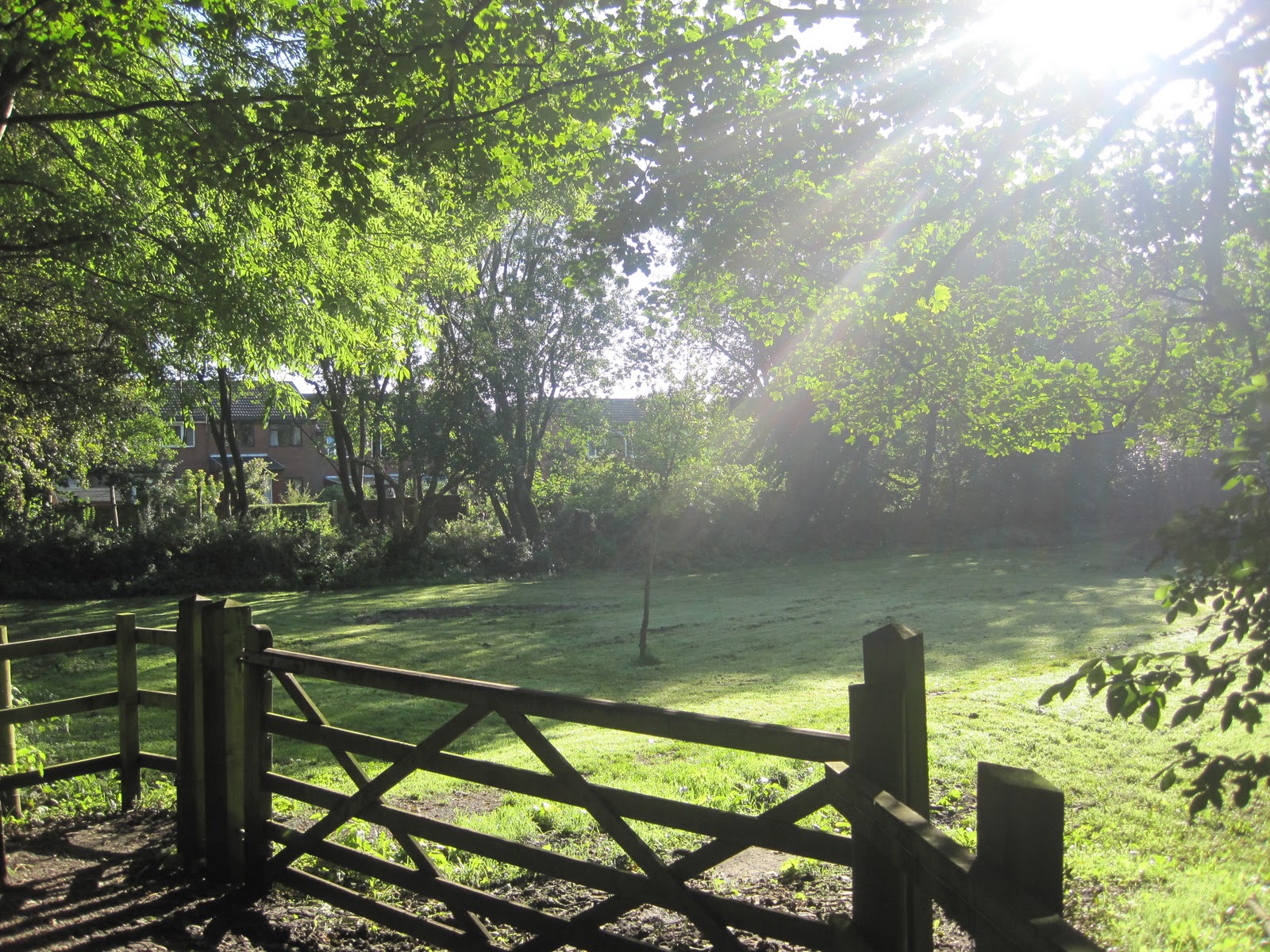
The Friends of Rhine Close field!

Oh, and did I mention I'm doing an A-Level (equivalent) course? I started that yesterday and the first assignment has now been sent off.

Phew, I'm exhausted just thinking about it all.

I have been trying to be more involved in local issues, as there are lots of things on our doorstep that we can do as a family. Last weekend we attended the Tottington Wildlife Watch Group. A group met in the community room in the library and we took the children along the Kirklees Trail searching for different trees and leaves. We had sheets printed off so they could be identified and they did really well, until they got to the first horse chestnut tree. Then, the afternoon turned into a big conker hunt! Still, they all got on well together and they were outside running about, so I think it went well. I've been asked if I'll help out so as long as it is just for the hour and a half every month I can't see any harm in that. The group meets on the 2nd Saturday of each month 2-3.30pm.

I have also attended the Friends Of Kirklees Valley meeting this week. This group are involved in the improvements along the 'lines' and a bat expert was there to advise about some changes. Apparently the Environment Agency (who are staying according to the list published today) want to 'naturalise' as many rivers as possible and they have highlighted a culvert near us. Batman thinks this will cause problems for our wildlife though! The completed stage of the Kirklees Trail will be a designated nature reserve from next week.

I will gather you something better for next week as, fingers crossed, we'll be out on Saturday. H is off to his first cub camp. For 1 night away he needs to take: 3 pairs of trousers, shorts, swimming trunks, 4 jumpers, 6 t-shirts, pyjamas, 6 pairs of underpants, 8 pairs of socks, a waterproof coat, wellies, trainers, sturdy shoes, plate, dish, mug, knife, fork, spoon, torch, sleeping bag, pillow and a teddy bear! Plus his cub uniform.

I leave you with my sort of dessert menu, and news of a new beauty salon in Radcliffe. Their advert states that with every male shoulder and back wax they will give free ear wax! I wondered about phoning them to point out their error, but it would spoil the fun.
My own ice-cream; it would be rude not to try it.